
Hike for Hope returns to Donner Memorial State Park for sixth year, pushing for suicide awareness in mountain communities
June 19th, 2025 | By: Zoe Meyer
TRUCKEE, Calif. — What began as a small virtual gathering during the height of the pandemic has grown into a key local effort to confront one of the region’s most pressing health issues: suicide.
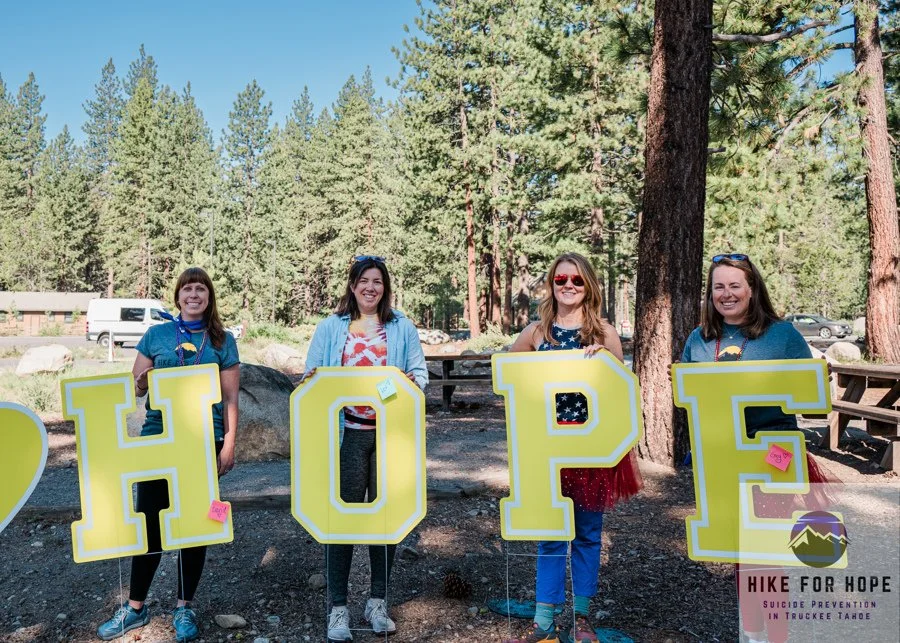
The sixth annual Hike for Hope returns to Donner Memorial State Park located at 12593 Donner Pass Rd. on Sunday, June 22, bringing community members together for a 3.2-mile hike to promote suicide prevention and mental health awareness. Organized by The Speedy Foundation, the event begins with registration at 9 a.m., followed by a 10 a.m. hike start. Participation is free and open to all ages—including leashed pets. Register here.
Founded by Truckee resident Danielle Segal and her friend Bridget, both survivors of suicide loss, the event was inspired by a suicide prevention walk they attended in Reno. The two launched the first hike in 2020 as a fully virtual experience amid COVID-19 restrictions.
Now, six years later, the Hike for Hope has evolved into a vibrant, in-person gathering, with participation steadily increasing.
“I think the longer we do this, the more the community knows about it,” Segal said. “Each year it grows by the number of hikers that contribute as well as the number of sponsors that are supporting the hike. And then this year we have a lot more organizations coming to the table, which is really exciting.”
This year’s event will feature participation from a range of partners, including Placer County, NAMI Nevada, the American Foundation for Suicide Prevention (AFSP), Tahoe Forest Hospital, and The Speedy Foundation.
Shannon Decker, executive director of The Speedy Foundation, has supported the event since its early days. She noted that a major shift came when organizers transitioned fundraising efforts to remain local. Previously, funds raised through AFSP could not be directed to services in the Truckee-Tahoe area. Now, with The Speedy Foundation as fiscal sponsor, those dollars stay in the region.
“We are almost doubling what we raised last year, and that is a huge kudos to Danielle and the planning team’s efforts,” Decker said. “Those funds will be used for Hope Squad programming, which is currently established at the two high schools and the two middle schools at TTUSD.”
Funds have also supported local suicide prevention messaging, public service announcements, printed outreach materials, and participation in a national research summit.
Still, assessing the effectiveness of suicide prevention work remains complex.
“Suicide is a really hard piece to measure,” Decker said. “We’re looking for a decrease in suicide rates, a decrease in suicide attempts, and an increase in use of local resources—especially the 988 Suicide and Crisis Lifeline.”
Segal, who works in the school system, shared a recent interaction with a student that underscored the growing awareness.
“One of my students came in and was really struggling,” she said. “At the end of our conversation, I made sure that she knew about 988, and she’s like, ‘Oh, yeah, I know about that. I have that card at home.’ Just hearing that she knew what I was talking about as, you know, a 12-year-old… I think word is spreading.”
Both women emphasized that suicide risk in mountain communities stems from a complex mix of factors: seasonal employment, housing scarcity, job insecurity, social isolation, and a culture that often normalizes substance use.
“When it makes headline news that mountain communities have higher suicide rates than other communities, it’s mainly because of clusters of suicides or suicide contagion,” Decker said. “We haven’t had a contagion of suicide locally in a while, and that goes back to the work that we’re doing to bring better awareness.”
That work, they say, begins with being willing to talk about suicide.
“I want everyone trained in suicide prevention the same way they’re trained in CPR rescue,” Decker said. “I want them to be prepared to have an uncomfortable conversation, and get to the point where they can ask the question directly: ‘Are you having thoughts of suicide?'”
The Hike for Hope remains a space for remembrance and healing—for those personally affected by suicide, for mental health advocates, and for anyone looking to support their community.
“It’s just a place to hopefully feel closer to the community,” Segal said, “and just know that you’re not alone.”