
Colin Hilton: A Legacy of Opening Doors
The Speedy Foundation joins the Park City community, the Utah Olympic Legacy Foundation, and so many others in mourning the loss of Colin Hilton. Colin died at his home in Park City on August 21, 2026. He was 58.
His family later shared, with extraordinary courage and honesty, that Colin had ended his own life after experiencing depression. Their decision to speak openly was both beautiful and brave. By telling the truth about what happened, they created space for others to recognize that suicide and mental-health crises can affect anyone—including people who are accomplished, admired, surrounded by community, and entrusted with significant leadership.
We often assume that successful people are somehow immune to mental-health crises. We may believe that people who lead strong organizations, build lasting institutions, support others, and appear to have a clear vision for the future must also feel strong internally.
Colin’s death reminds us that professional success, leadership, knowledge, community involvement, and proximity to resources do not make anyone immune to depression or suicide risk. A person can be deeply loved, highly capable, future-focused, and still experience pain that becomes difficult to see beyond.
We extend our deepest sympathy to Colin’s family; his colleagues; and the many people who knew and loved him. His family’s beautiful obituary describes a man who opened doors, championed people who might otherwise have been overlooked, and cared deeply about building something that would last.
That is also the Colin we knew.
Where Speedy’s Athletic Life Took Shape
The Utah Olympic Park was much more than a competition venue to Jeret “Speedy” Peterson. It was his training ground, his community, and his second home. Speedy spent the majority of his life as an athlete training at the Utah Olympic Park. It was where he developed his skills, built lifelong friendships, and experienced both the joy and intensity of pursuing an Olympic dream. The Park was inseparable from his story.
Colin understood that.
When The Speedy Foundation was established following Speedy’s death in 2011, Colin recognized that honoring Speedy’s legacy meant returning to the place where so much of his life had unfolded. It also meant creating opportunities for other young people to experience the belonging, purpose, challenge, mentorship, and joy that sport had given Speedy.
Hurricane for Hope: Two Foundations Joining Forces
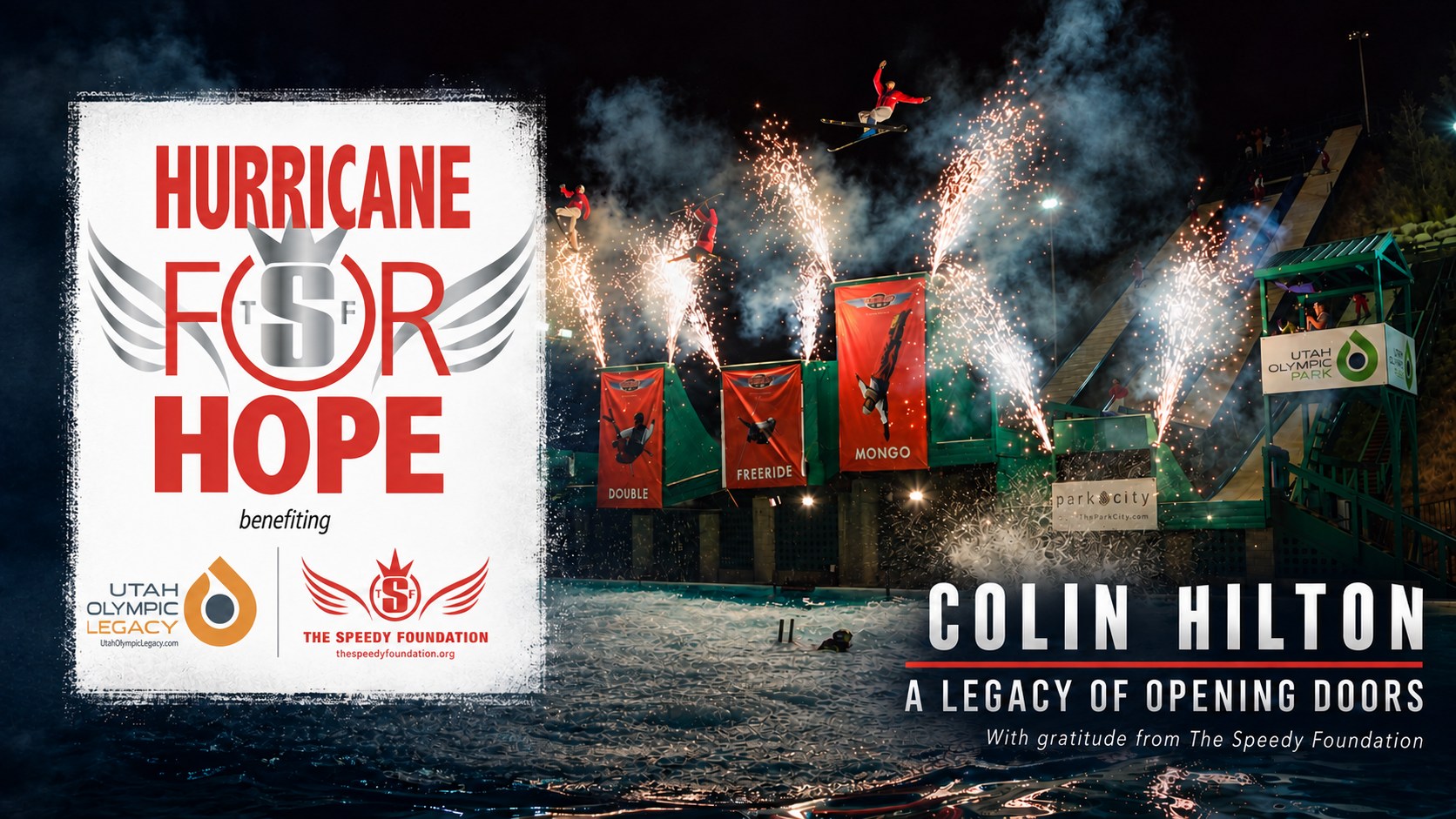
In 2012 and 2013, the Utah Olympic Legacy Foundation and The Speedy Foundation co-hosted the first two Hurricane for Hope fundraisers at the Utah Olympic Park. These were not simply Speedy Foundation events held at the Park. They were a true partnership between two foundations with complementary missions.
Hurricane for Hope brought together athletes, families, community members, entertainment, and a Big Air aerial show. Young athletes from local freestyle clubs competed for the Spirit of Speedy Award, creating an evening that celebrated Speedy’s life while opening an honest conversation about mental health and suicide prevention.
Funds raised benefited both The Speedy Foundation and the Utah Olympic Legacy Foundation.
In a 2013 interview with The Park Record, Colin explained that the two organizations chose to join forces rather than hold separate fundraisers. Together, the foundations could promote youth participation in winter sports, increase awareness of mental health and suicide, challenge stigma, and strengthen support systems around athletes.
Colin said they wanted to create the event at “a place where Speedy practiced for years.”
That choice mattered. Hurricane for Hope connected Speedy’s athletic legacy with a broader understanding of prevention: helping young people develop supportive relationships, meaningful roles, healthy ways to cope, and places where they feel they belong.
Constructive recreation can be a powerful protective factor. Sport does not eliminate mental-health challenges or suicide risk. However, a healthy recreational environment can surround a person with coaches, teammates, trusted adults, routines, goals, physical activity, opportunities to contribute, and a shared sense of purpose.
These protective factors can help counter or decrease the effect of risk factors in a person’s life. They can give someone more people to turn to, more reasons to stay connected, and more opportunities for others to notice when something has changed.
That was the deeper connection between our two foundations.
The Speedy Foundation was working to prevent suicide through education, awareness, and stronger support systems. The Utah Olympic Legacy Foundation was creating accessible opportunities for young people to participate in sport and become part of a community.
Colin wanted to ensure UOLF had the “facilities and programs available to our youth.” He emphasized that these opportunities were not meant only for international athletes. He wanted young people throughout the community to have an affordable way to discover winter sports.
He understood that opening the door to recreation could also open the door to connection, confidence, mentorship, and hope.
Helping Build Project Big Air
As the Utah Olympic Park prepared to remodel and expand its facilities through Project Big Air, The Speedy Foundation was proud to make a financial contribution. It was a significant donation for our small and young organization. We made it because we believed in the project, in the Park, and in the living legacy Colin and his team were creating. Supporting Project Big Air was another way to honor the place where Speedy had spent so many years training while helping ensure that future generations would have access to the same sense of possibility.
Colin helped us understand that an Olympic legacy could be about far more than preserving a venue or remembering a historic event. A living legacy creates opportunities for young people, supports athletes and families, strengthens a community, and continues evolving to meet new needs. Colin’s favorite expression was, “The road to success is always under construction.” Project Big Air made that idea tangible. The physical construction mattered, but so did the community being built around it.
Giving Mental Health Work a Place to call Home
Colin and the Utah Olympic Legacy Foundation continued supporting The Speedy Foundation long after Hurricane for Hope. Over the years, UOLF generously provided in-kind space for Mental Health First Aid and Youth Mental Health First Aid trainings, suicide-prevention education, community-planning meetings, and conversations about resilience and mental wellness.
The Utah Olympic Park became a home for work that might otherwise have struggled to find a place. In 2016, Colin and his team helped host community mental-health programming at the Park, shared information through their networks, coordinated logistics, and welcomed partners into the space.
In 2018, a Mental Health First Aid training filled and developed a large waitlist. When we asked Colin whether the Utah Olympic Park might have space for an additional session, he responded immediately that he would be happy to help and connected us with the staff responsible for the meeting rooms. He personally connected us to Maxwell’s to ensure that we didn’t lose money on catering for our free community event and that had a quality food experience.
In 2020, the Park again hosted a Youth Mental Health First Aid opportunity intended in part to give coaches additional tools to recognize and respond when a young person might be struggling. Colin understood that coaches, mentors, teammates, colleagues, and community members can all play an essential role in prevention. His support helped us place practical, potentially lifesaving knowledge into more hands. He did not need to be at the center of that work. Often, his contribution was simply making it possible and that was incredibly meaningful to us when the subject matter was so highly stigmatized.
Linked by Legacy
One of our most meaningful full-circle moments came when we hosted a Linked by Legacy summit at the Utah Olympic Park, with guests staying in the Park’s new residences. Linked by Legacy is a national collaborative gathering of suicide prevention organizations that were established in memory of a significant community member. The gathering brought together people connected by suicide loss legacy, purpose, and a desire to turn painful experiences into meaningful action. We brought in Utah’s Rep. Steve Eliason and Utah’s Suicide Medical Examiner Dr. Michael Staley to present to these national nonprofit partners. Two of Utah’s key champions for suicide prevention sharing their incredible work while watching athletes water-ramp and chase dreams.
Years earlier, Colin had helped us imagine what could grow at the Park. Later, the expanded facilities became a place where people could stay, gather, learn from one another, and build relationships centered on hope. That moment captured so much of what Colin helped create—not merely a collection of world-class facilities, but a place where people could connect and build something larger than themselves.
He Helped Make the Work Possible
Our email exchanges with Colin span many years, but their tone is remarkably consistent.
He was encouraging.
He was responsive.
He was generous with connections.
He celebrated stories that linked athletes with Speedy’s legacy.
He shared our trainings and events with others.
He connected us with staff and community partners. He helped us find space.
He showed up.
The Speedy Foundation would not have built the same foundation in Park City without Colin’s support. His death is especially painful because he was such a strong supporter of suicide-prevention and mental-health work. It reinforces a truth our field must continue communicating: knowing about mental health is not the same as being protected from a mental-health crisis.
People who spend their lives supporting others may still struggle to disclose their own pain. Leaders may fear disappointing the people who depend on them. Success can sometimes make it harder for others to recognize distress—or for the person experiencing it to believe they are allowed to ask for help.
No title, accomplishment, level of responsibility, or history of helping others makes a person immune.
Colin’s family shared that suicide was something that happened to him, not something he had wanted or planned. He wanted relief from depression and a way back to the life and people he loved. Even shortly before his death, he was looking toward the future and trying to find his way back. Their message is clear: you are not alone, and it is always okay to tell someone what you are carrying.
We are profoundly grateful to Colin’s family for sharing this truth during a time of unimaginable grief. Their honesty honors Colin’s full humanity and may help another person or family recognize a crisis, begin a difficult conversation, or reach for support.
Carrying His Legacy Forward
Colin’s legacy can be seen in the Olympic venues he helped sustain, the athletes who trained there, the children who discovered a new sport, and the opportunities created for people who might otherwise have remained on the outside. Come the 2034 Winter Olympic Games in Utah, Colin’s legacy will be there. But, it can also be seen in quieter actions that may never appear in an annual report:
The introduction.
The meeting room.
The encouraging email.
The willingness to share an event.
The decision to join forces instead of working separately.
The simple response: “I’d be happy to help.”
We will remember Colin for all of those things. We will remember his belief in legacy. We will remember how he helped us build ours.
And we will continue working toward a world in which recreation, education, relationships, and community create stronger networks of support around every person—a world in which someone experiencing depression can see another path forward and feel safe telling someone when they need help carrying what has become too heavy to carry alone.
Thank you, Colin, for believing in The Speedy Foundation during our earliest years.
Thank you for bringing our organizations together for Hurricane for Hope.
Thank you for helping us honor the place where Speedy spent so much of his life.
Thank you for welcoming us into the Utah Olympic Park and giving our work space—both literally and figuratively—to grow.
You helped make hope possible for others.
We will carry that forward.
Celebration of Life
The Utah Olympic Legacy Foundation will host a public celebration honoring Colin and the countless lives he touched, inspired, and enriched: Wednesday, September 23, 2026, 6:00–9:00 p.m.
Additional information and event updates are available through the Utah Olympic Legacy Foundation’s Celebration of Life page.
References and Related Links
Colin Hilton Celebration of Life — Utah Olympic Legacy Foundation
“Foundations Join Forces for Second Annual Hurricane for Hope” — The Park Record, August 20, 2013
If you or someone you know is struggling or experiencing a mental-health or suicide crisis, call or text 988 to reach the 988 Suicide & Crisis Lifeline. Support is available 24 hours a day, seven days a week. If there is an immediate danger or medical emergency, call 911.
Help Us Continue This Work
The Speedy Foundation works to prevent suicide and elevate mental health action through education, advocacy, and honest conversations. Your support helps us provide trainings, resources, and programs that bring help, hope, and connection to communities.