

TSF Blog
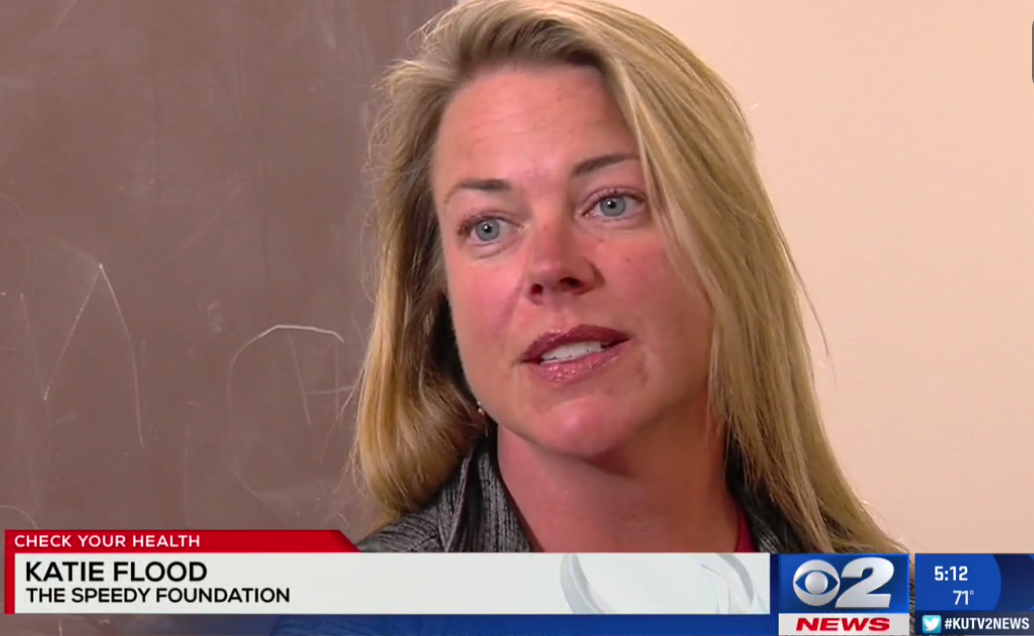
Check Your Health: Mental health first aid
By Leslie Tillotson, KUTV2
SALT LAKE CITY -- Knowing CPR or the Heimlich maneuver may save a life, but what if you come in contact with someone suffering a mental or emotional crisis? Would you know what to do? Fortunately, Optum and The Speedy Foundation have teamed up to provide free mental health first aid training.
Major life changes such as a breakup, loss of job, or the death of a loved one can trigger situational depression. Those are times someone might be having some difficulty. So check-in, be straightforward, and if they're struggling, ask tough questions.
"Don't be afraid to ask the real question that you want to know. 'Are you thinking about killing yourself?'" emphasizes Flood.

Groups offer free classes in Utah on ‘first aid’ for mental health issues
SALT LAKE CITY – Research shows roughly one in four people deal with mental health issues in Utah, and a new class is providing people the "first aid" lessons they need to help loved ones who are suffering.
“These classes provide an amazing bridge to understanding what mental health is, the various levels of it, and how you can start talking to somebody,” said Katie Flood of The Speedy Foundation.
Experts say mental health is a subject that's been scary to talk about in the past but isn't so easy to avoid anymore. Suicide is a major health problem in Utah and a leading cause of preventable death.
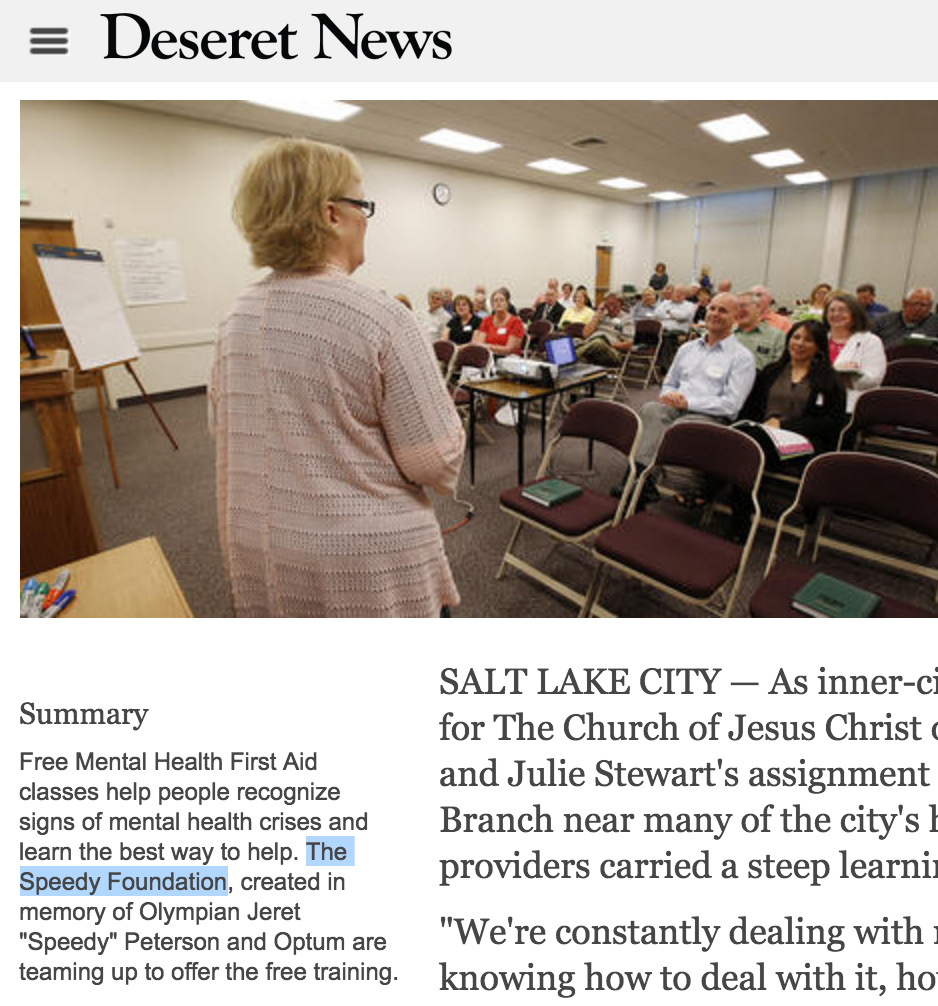
How you can be trained to recognize signs of mental health crises and help
By Marjorie Cortez, Deseret News
SALT LAKE CITY — As inner-city service missionaries for The Church of Jesus Christ of Latter-day Saints, Don and Julie Stewart's assignment to the Rio Grande Branch near many of the city's homeless services providers carried a steep learning curve.
"We're constantly dealing with mental illness and not knowing how to deal with it, how to handle it, how to recognize it or the right things to do or the wrong things," Don Stewart said.
To help inform and guide their efforts, the Stewarts are enrolled in a Mental Health First Aid class where they are learning to recognize signs of mental health crises and suicide and to develop an action plan to help someone in crisis.
The Stewarts say the training is so valuable, they've enrolled in the eight-hour class for a second time.
"This class was a game changer for us. It was like, 'OK help us understand,' because we were not addressing the mental heath issues. We were, 'Let's get you back to work. Let's get you housed. Let's get you out of the shelter,' and people were just coming right back to the shelter," Julie Stewart said.
The training is provided free of charge in a partnership between The Speedy Foundation, which was formed in honor of three-time Olympian Jeret "Speedy" Peterson, who died by suicide in July 2011, and Optum, which manages Salt Lake County's mental health and substance use services under contract with the county's Division of Behavioral Health Services.

75 Ways Team USA Athletes Give Back To The World
Three-time Olympic freestyle skier Emily Cook sits on the board of The Speedy Foundation, a philanthropic organization dedicated to understanding mental illness through education, research and advocacy, founded in honor of Olympic medalist aerialist Jeret "Speedy" Peterson. She is also involved in the organization Right To Play.

Olympian Emily Cook On Mental Illness And Life Transitions: “Talking Is Key”
September is Suicide Prevention Awareness Month, and for many of us an opportunity to reflect on and honor those who have struggled. For me, it is a time to remember my teammate and very good friend Jeret “Speedy” Peterson and, in his honor, to look deeply at how we can all support each other.
While a loving, caring, outgoing friend, Jeret battled depression throughout his life. Less than 18 months after winning a silver medal at the Vancouver 2010 Olympic Winter Games and retiring from competitive sport, Jeret took his life in July of 2011 at the age of 29. This was a devastating time for his family, teammates and friends, but in the spirit of his passion for giving back to others, The Speedy Foundation was founded and today is focused on understanding mental illness, preventing suicide and fighting stigma through education, research and advocacy.
There are so many positive things that come out of sport: perseverance, dedication and an unwillingness to give up among them. But often times this grit, which has been so engrained, can prove challenging, especially after retiring from sport. As an athlete at the Olympic level it’s easy to define yourself by your sport. When you retire, who are you? The challenges of major transition in life can be tough for all of us, not just athletes.

Speedy Foundation to Host Seminar
On Wednesday, Sept. 9, The Speedy Foundation and the Park City Sport and Wellness Coalition will host a seminar at Park City High School about recognizing the signs of mental health problems and the stigma of talking about suicide.
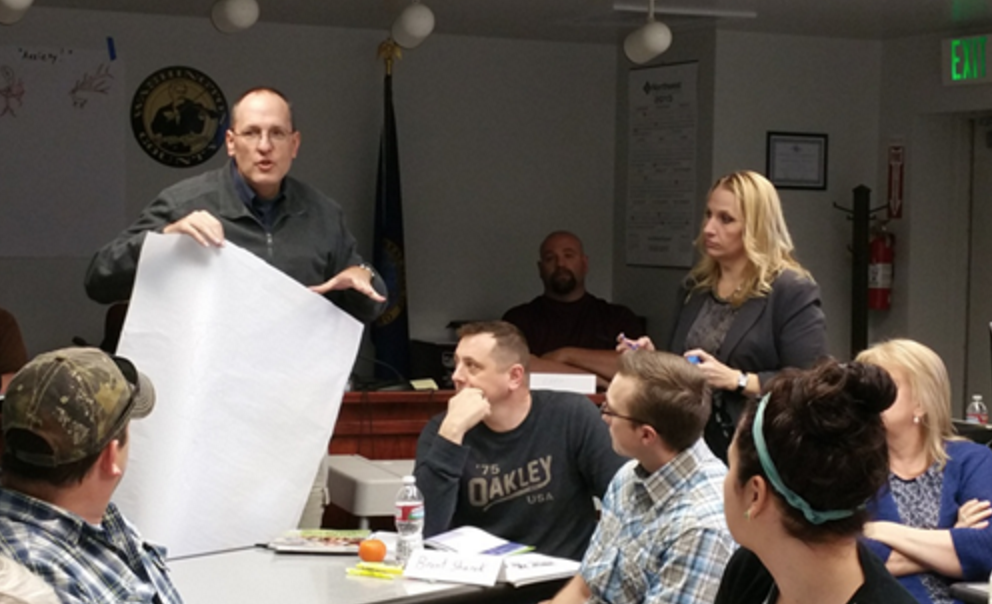
Mental Health First-Aid Training: As Critical for Idaho as CPR
By Jessica Murri, Boise Weekly
While a first-aid class offers instruction on what to do when someone is having a heart attack, The Speedy Foundation and Optum Idaho believe mental first-aid training is just as critical. The organizations came together to offer training sessions that equip students with an action plan on how to recognize and assist someone in a mental health crisis. The 12-hour courses help students learn to identify different types of mental illness like depression, eating disorders, substance abuse and anxiety; and how to assess for risk of self harm or suicide; how to listen non-judgmentally and how to get assistance when needed.
"It helps people to recognize the signs: what people are saying or hinting at," said Georganne Benjamin, the communications director for Optum Idaho, an organization that manages outpatient mental health services for Idahoans enrolled in Medicaid through the Idaho Behavioral Health Plan. "It might not be obvious to most people, but if you've gone through this, you've been trained to see and respond to those types of signs."
The Speedy Foundation, which was founded after three-time Olympic skier and Boise native Jeret "Speedy" Peterson committed suicide in 2011, agreed to help Optum Idaho offer training sessions across the state during the past year. So far, sessions have taken place in Boise, Idaho Falls, Salmon, Weiser, Shoshone, Montpelier, Idaho City and Grangeville.
"Our goal in launching the program was to really bring it to rural communities, where access to services are not as available as larger cities," Benjamin said.
Idaho high-school students reported seriously considering suicide. By offering mental first-aid courses, Optum Idaho and The Speedy Foundation hope to curb that.
Armed with a sign, Park City High School student spreads message that has gone viral
Robbie Borders wants people to know suicide is not the answer
By Bubba Brown, The Park Record
Robbie Borders wants to make your day better.
And it's likely he has if you've happened to drive by him over the past few months. Every day after school, the Park City High School student has been holding a sign on State Road 224 that delivers a hopeful message: "Smile, you are beautiful."
Borders' message soon went viral around the state when his friend posted a picture of him with his sign on social media. Seemingly everyone, he said, was talking about what he was doing. On Monday, he was honored for his efforts during the high school's annual recognition assembly.
"I've been getting a lot of good feedback," he said. "I've had people pulling over and telling me I've been doing a good job and making people's day."
Borders' inspiration for the idea came from a friend who committed suicide. Borders wanted others to know that isn't the only way out. "He had told people to smile, even though he was suffering depression," Borders said of his friend. "So I thought it would be a good idea to put up a sign to show to other people saying that, 'You can smile because you're original, and no one can judge you because of that.'"
Other students quickly took notice. The Summit County Suicide Prevention Coalition had tasked the school's Latinos in Action club with forming a suicide awareness campaign. The club immediately thought of Borders and centered the campaign around his message.
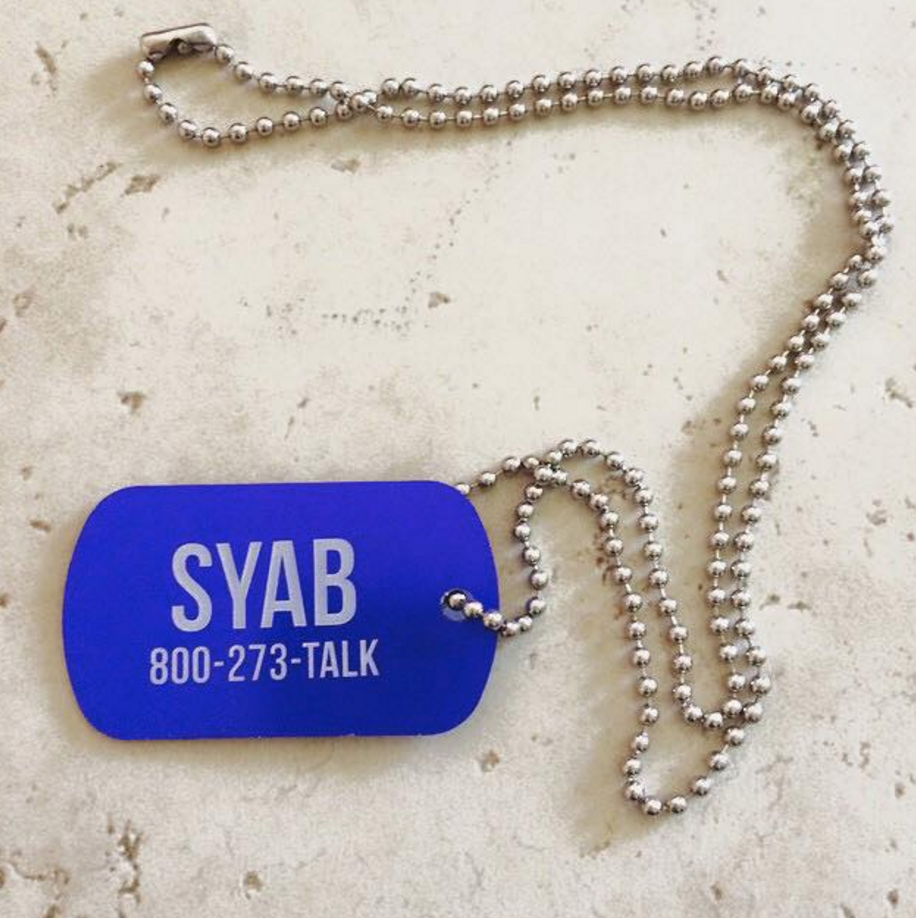
As part of the campaign, students were given dog tags that read "SYAB" as they left the assembly Monday. They were asked to take pictures with the dog tags and something or someone that is special to them and post them to social media with the hashtag "#worthliving."

Mental Health First Aid training available
The Speedy Foundation, an organization dedicated to preventing suicide through education and outreach in the athletic community, is partnering with Optum Idaho to offer free Mental Health First Aid training sessions throughout the state.
Mental Health First Aid is a day-and a-half-course that teaches people how to recognize the most common signs of mental illness including depression, anxiety disorders, eating disorders and substance abuse, and the steps they can take to help someone get professional help. The Speedy Foundation will fund 10 training sessions during the next year and act as a statewide champion for suicide prevention and mental health awareness. The courses will be taught by certified Mental Health First Aid instructors from Optum Idaho.
The next course will be offered in Sandpoint on Thursday from 9 a.m. to 4 p.m. and Friday from 9 a.m. to 12:30 p.m. For more information or to register for a future session, contact Optum Idaho at (208) 914-2013 or amanda.lehto@optum.com.

The Science Behind Suicide Contagion
When Marilyn Monroe died in August 1962, with the cause listed as probable suicide, the nation reacted. In the months afterward, there was extensive news coverage, widespread sorrow and a spate of suicides.

Emily Cook: 'I left no stone unturned'
Cook said Friday that she might keep going if she thought her body could withstand it, but will be content to view the Olympics from another vantage point next time around. "I don't know where I'll be," she said, gesturing around the base of the hill where coaches, reporters and spectators stood in different pens, but said she'll remain connected to the sport.
Off the hill, she has already found long-term purpose in her involvement with the Speedy Foundation, established by Peterson's family and friends after his death to tackle mental health issues and suicide prevention. Cook has been one of the most visible faces of the organization, which was instrumental in starting the first suicide hotline in Peterson's home state of Idaho.
In an email, Linda Peterson, Jeret's mother, called the petite Cook "a gentle and giant spirit ... the most gracious and empowering person I know."

Sochi Olympics: Emily Cook wraps up career, salutes 'Speedy' Peterson
By Lisa Dillman, Los Angeles Times
"I’m sad not having him here, of course,” Cook said. “But my mission is to carry on what he started, to carry on his legacy, to continue having conversations about mental health.
"To have conversations about depression, to get people help when they need help. All of that."

Emily Cook wraps up Olympic career as aerial artist
By Jason Blevins, The Denver Post
Maybe it was a stoic face she was putting on for reporters, but Cook did pause when asked about her good friend Jeret “Speedy” Peterson, the three-time Olympian and silver medalist in the 2010 Winter Olympics who took his life in a remote canyon in Utah in July 2011.
“He would have been bummed I didn’t hit the second jump,” Cook said. “He’s with me. He’s here. I’m positive of that. My mission is to carry on what he started. To continue on with his legacy. To continue to have conversations about mental health … conversations about depression. To get people the help they need.”
Cook said she would remain in aerials in part because of the influence of Peterson.
“He taught us how to be a team and I’m going to teach the younger athletes how to do that, too,” she said. “Man, our future is so good in our sport. These kids are so good at 16, 17 years old and Speedy was too and look at what he did.”

Freestyle skier Dylan Ferguson pushes boundaries
He pays homage to late 'Speedy' Peterson with aerial tricks but hasn't landed spot in Sochi yet
By Lisa Dillman, Chicago Tribune
Regardless of who makes the team, there's little doubt that the members of the men's and women's aerial teams in Sochi will be asked about the impact and legacy of Peterson, the man behind the Hurricane.
In 2011, Peterson took his own life in a remote canyon in Utah. He had battled depression and spoke openly in Vancouver and before the Olympics about his long struggle with drinking and two suicide attempts.
The tight freestyle ski community pulled together to honor Peterson, not only domestically but internationally. Ferguson had traveled the World Cup circuit with Peterson for at least five seasons.
"He was awesome, always having a blast, always having a smile on his face," Ferguson said.

The Last Flight of Speedy Peterson
Olympic athletes are unique in that for most, their sport is in the spotlight only once every four years, so the weight they carry into competition can feel magnified. A small stumble can feel like four years of training has been for naught and an entire nation has been let down. Mentally and emotionally, it can be a delicate balancing act.

Jeret ‘Speedy’ Peterson: A Life On the Edge
14 Photographs of Peterson, an Olympic freestyle skier, committed suicide in 2011 after battling depression.

Up in the air: The life of Speedy Peterson
When Olympic medalist Jeret "Speedy" Peterson snapped on skis and took a jump, something extraordinary happened. He twisted his body in ways few have. Off the slope, the life of the freestyle skier had twists of its own.

Who is Kerry Miller, and What’s He Do?
By Devon O'Neil, Powder Magazine
The two worlds gradually merged, and in 1996 he met Speedy, a tough kid from a broken home who would become his “son de facto.” “To see all the hardships Speedy came from and how he came alive as a person, that made me be sure I did this more,” says Miller.
Two years later, Darla Hall was looking for a place for her son Tanner, then a promising teenage moguls skier, to live while he pursued a pro career in Park City. Speedy befriended Tanner, and Miller agreed to take him in. “Kerry was a father figure to Tanner,” says Darla. “He had a huge influence on him.”
During one stretch, Miller had eight kids living with him, including future pros Mike Wilson and Timy Dutton. He shuttled them to and from school in a van. He cooked for them, disciplined them. “Think of Kerry as an uncle, father, coach, policeman and mother—heavy on mother,” says Chris Goepper, Nick’s father. “And he likes the underdog because there’s a lot of people out there who come from means in the ski world, and he likes to try and help the underdog figure out a way to make it.”

Motorcycle Ride Benefits Idaho Suicide Hotline
Idaho is the only state that doesn’t have a suicide hotline. Right now, calls are directed to Oregon. But Judy Gabert, Suicide Prevention Action Network’s Resource Specialist, says that poses problems. The national hotline doesn’t know all the local resources available to Idahoans. This can lead to misinformation on where a person should go to get help.

AFSP's 24TH ANNUAL GALA FOR SUICIDE PREVENTION
A renewed sense of optimism filled the Museum of Modern Art in New York City on May 17, 2012 as AFSP’s Lifesavers Dinner raised close to $450,000 for suicide prevention research, education and advocacy.
Melissa and over 250 guests were on hand to honor Peter Chiarelli, a retired Army general who has become a powerful voice for suicide prevention; Mariel Hemingway and Natalie Morales, two public figures who helped bring national attention to the problem of suicide while decreasing the stigma surrounding mental illness; and Dr. Gustavo Turecki, a researcher who has contributed to the understanding of brain genetics and their association to suicide.
Natalie Morales received the Public Education Award from Linda Peterson, who lost her son, Jeret, who was Natalie’s friend, to suicide.